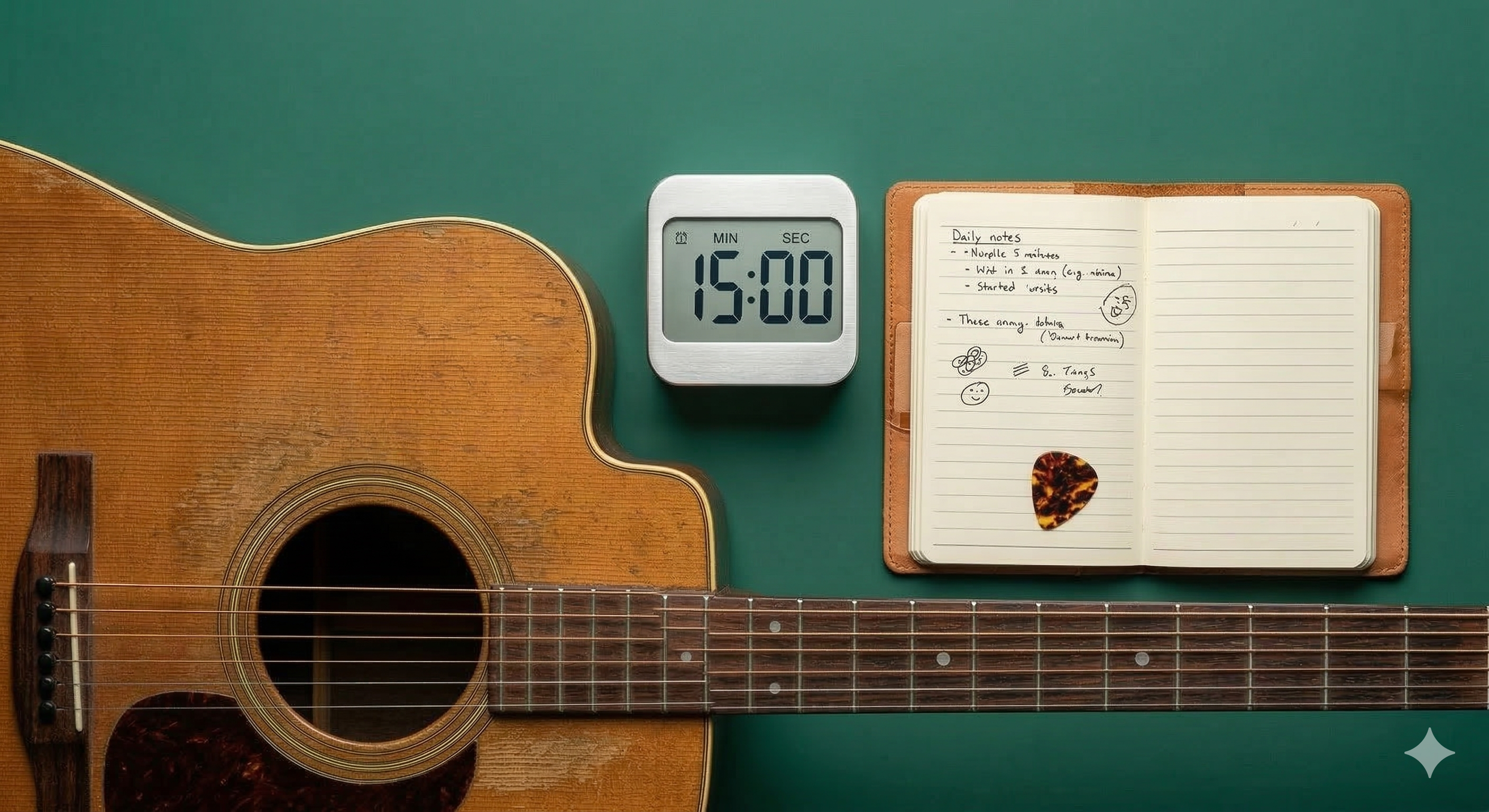
Here's a scenario many aspiring guitarists face: your weekday schedule is packed, so you plan to make up for it with long weekend practice sessions. Two hours on Saturday, maybe another hour on Sunday — that should equal out, right? Unfortunately, the science of learning says otherwise.
Motor skill acquisition — which is what guitar playing fundamentally is — depends on repetition and consolidation. Your brain needs to process each practice session, strengthen neural pathways during sleep, and then re-activate those pathways in subsequent sessions. This process requires frequency more than duration.
The magic of daily practice: When you practice 15 minutes daily, you're activating your guitar-related neural pathways seven times per week. Each activation strengthens the connections. Each sleep cycle consolidates the learning. By the end of the week, you've had seven learning cycles.
The limitation of weekend-only practice: When you practice only on weekends, you get two activation sessions with five days of inactivity between them. Those five days allow neural pathways to weaken. Each weekend session starts by re-establishing what faded during the week, rather than building on solid progress.
Studies in motor learning consistently show: distributed practice (spread over multiple days) produces better retention than massed practice (concentrated in fewer sessions). This holds true across piano, typing, athletic skills, and yes, guitar.
The math doesn't work out either: 15 minutes x 7 days = 105 minutes weekly. 2 hours on Saturday + 1 hour on Sunday = 180 minutes weekly. The weekend warrior technically practices more minutes — but learns less effectively. Time isn't the only variable; frequency is equally crucial.
But what if you genuinely can't practice daily? Life happens. Some schedules truly don't allow daily guitar time. Here's a middle ground: aim for at least 4-5 practice sessions per week, even if they're brief. Ten minutes on busy days is infinitely better than zero minutes. The goal is maintaining neural pathway activation frequency.
Quality matters within sessions too. A focused 15-minute session with specific goals (practice G-C transition, work on strumming pattern) beats 2 hours of unfocused noodling. When time is limited, structure is your friend. Chordie AI's daily lessons are designed to maximize learning in minimal time.
The fatigue factor: Long practice sessions lead to diminishing returns. After about 45-60 minutes, most beginners' concentration wanes. Fingers tire. Mistakes increase. You might be "practicing" but you're actually reinforcing errors. Shorter sessions stay in the high-quality zone.
Callus development also favors consistent short practice. Your fingertips need regular exposure to strings to build calluses, but they also need recovery time between sessions. Daily 15-minute sessions provide the ideal balance. Weekend-only practice can actually extend the painful period because calluses don't develop consistently.
What about intermediate/advanced players? The daily principle applies at all levels, though session lengths can increase. A professional might practice 3-4 hours daily, but they're still practicing daily, not cramming everything into weekends.
How to make 15 daily minutes work: Keep your guitar out of its case, visible and accessible. Friction kills habits; removing friction enables them. Practice at the same time daily to build routine. Use Chordie AI's structured lessons — they're designed for exactly this time commitment. Don't wait for motivation; discipline matters more.
What if you have more time some days? Great! Practice more. The 15-minute minimum is a floor, not a ceiling. On relaxed evenings, play for an hour. On busy mornings, do your 15 minutes. The key is that 15 minutes happens no matter what.
Track your practice. Chordie AI logs your sessions automatically, showing your streak and cumulative practice time. Seeing the numbers reinforces the habit. Breaking a long streak hurts, which motivates you to find those 15 minutes even on difficult days.
The verdict is clear: 15 minutes daily beats 2 hours on weekends for skill development, retention, and callus formation. If you're serious about learning guitar, commit to daily practice. Your future guitarist self will thank you.
Chordie Team
VerifiedMusic Education Experts
The Chordie Team consists of professional guitarists, music educators, and AI engineers passionate about making guitar learning accessible to everyone. With decades of combined teaching experience, we create content backed by proven pedagogical methods.
Learn more about usShare this article