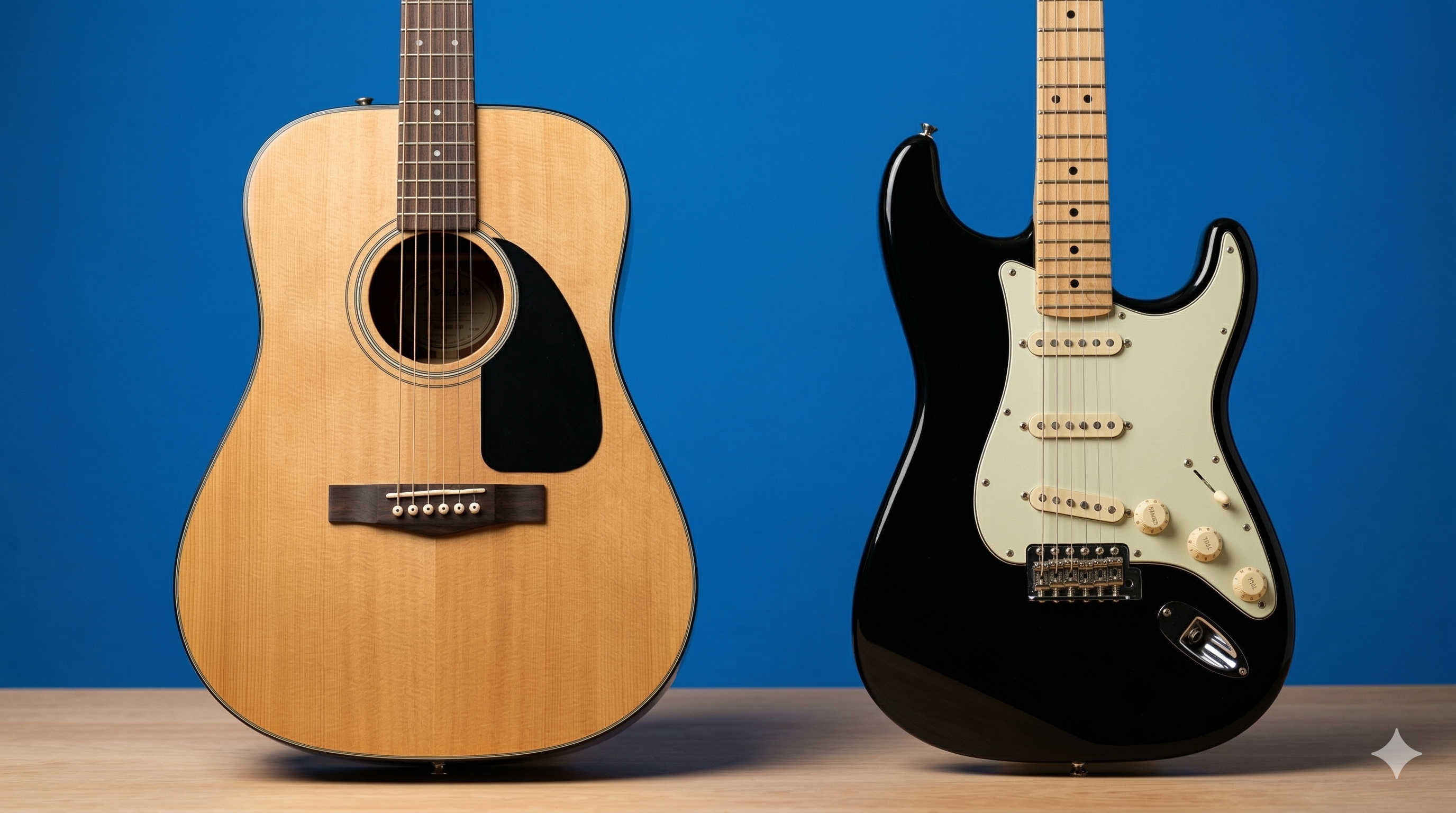
It's the age-old debate: should beginners start with acoustic or electric guitar? You'll find passionate advocates on both sides, each claiming their preferred instrument is the "right" way to learn. The truth is more nuanced — and the best choice depends entirely on you.
Let's start with acoustic guitars. They're self-contained: no amp, no cables, just pick up and play. This simplicity is appealing for beginners who want to minimize setup time and maximize playing time. Acoustic guitars are also portable, making them great for practice anywhere.
Acoustics have heavier strings (typically .012-.054 gauge) and higher action (string height), which means they require more finger pressure. This builds finger strength quickly but also means more initial finger pain. Many argue this is a feature, not a bug — if you can play acoustic, electric will feel effortless later.
Acoustic guitars produce a warm, full sound that works for many genres: folk, country, pop, singer-songwriter, and more. If these styles resonate with you, acoustic makes sense.
Electric guitars, on the other hand, have lighter strings (.009-.042 typical) and lower action, making them easier on beginner fingers. You can play for longer before fatigue sets in, and chord shapes require less pressure to sound clean. For this reason, some teachers actually recommend electric for beginners, especially younger players or those with smaller hands.
Electrics need an amplifier to be heard properly, adding cost and complexity. However, many beginners enjoy this — tweaking amp settings and effects is part of the fun. Modern practice amps are affordable and include headphone jacks for silent practice.
Electric guitars excel at rock, metal, blues, jazz, and many contemporary styles. If these genres excite you, starting on electric keeps you engaged because you're playing the sound you actually want to create.
Here's the honest truth: the best guitar for you is the one you'll actually practice. If you dream of playing Metallica riffs, an acoustic won't inspire you. If you envision campfire sing-alongs, an electric feels wrong. Your emotional connection to the instrument matters more than any technical consideration.
Both instruments teach the same fundamental skills: chord shapes, strumming patterns, music theory, and rhythm. What you learn on one transfers directly to the other. Many professional guitarists switch between acoustic and electric constantly. Starting on one doesn't limit you to that type forever.
Budget considerations: Entry-level acoustic guitars are generally cheaper since you don't need an amp. A decent beginner acoustic runs $150-300. A beginner electric setup (guitar + amp) typically costs $200-400. Both ranges can get you a quality instrument that won't hold back your learning.
Physical considerations: If you have smaller hands or less finger strength, electric's lighter strings provide an easier entry point. If you're concerned about noise (apartment living, late-night practice), acoustic can be played quietly without an amp, or electric can be played through headphones — both work.
Regarding Chordie AI: the app works with both acoustic and electric guitars. The AI listens to your playing regardless of instrument type, providing real-time feedback on chord accuracy and timing. Whether you strum an acoustic or shred an electric, Chordie adapts to help you improve.
Our recommendation: if you have a strong preference, follow it. Your enthusiasm will carry you through the difficult early months better than any "optimal" choice. If you're truly undecided, consider these questions:
What music do you want to play? Let that guide you. Where will you practice most often? Acoustic's portability or electric's headphone option might matter. What's your budget? Include amp costs for electric. Can you try both before buying? Many music stores let you test instruments.
There's no wrong answer. Both acoustic and electric guitars have produced legendary musicians. Pick the one that excites you, commit to consistent practice, and let Chordie AI guide your journey regardless of which path you choose.
Chordie Team
VerifiedMusic Education Experts
The Chordie Team consists of professional guitarists, music educators, and AI engineers passionate about making guitar learning accessible to everyone. With decades of combined teaching experience, we create content backed by proven pedagogical methods.
Learn more about usShare this article