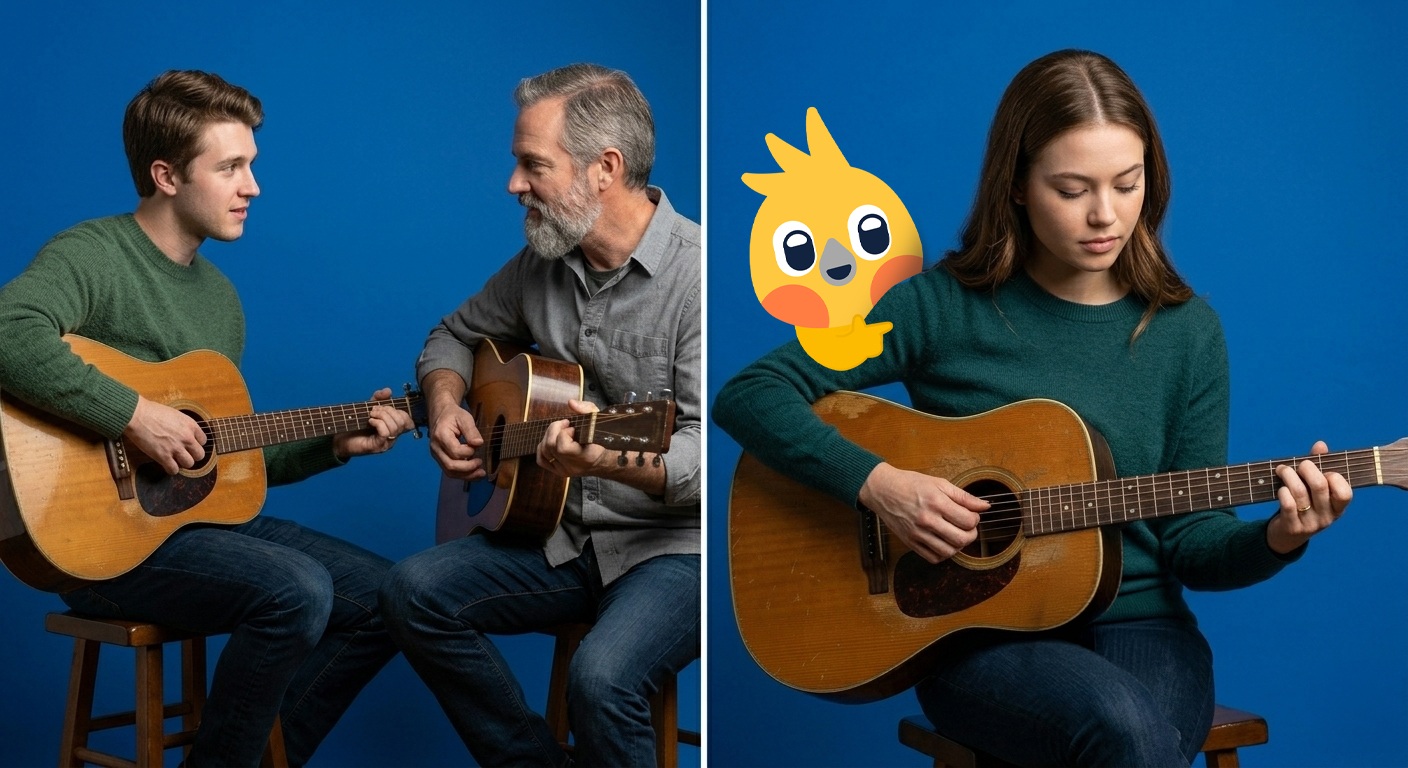
Should you learn guitar from a teacher or from an app? It's not a trick question — both approaches have genuine strengths and weaknesses. Here's an honest comparison to help you decide what's right for your situation.
Traditional lessons: The strengths
Human connection matters. A good teacher does more than demonstrate techniques — they read your frustration, offer encouragement, share stories, and create relationship. This human element can sustain motivation through difficult periods.
Personalized, nuanced feedback. An experienced teacher notices subtleties that current technology might miss: tension in your shoulders, inefficient finger movement patterns, emotional disconnect from the music. They adjust instruction based on holistic observation.
Accountability structures practice. Knowing you have a lesson next week — and that your teacher will notice if you didn't practice — motivates preparation. This external accountability helps many learners stay consistent.
Curriculum flexibility. Teachers adapt in real-time. Having a rough day? They might pivot to something fun rather than drilling technique. Ready to advance faster? They push you accordingly. This flexibility matches human rhythm in ways algorithms still can't.
Traditional lessons: The weaknesses
Cost adds up. Lessons typically range from $30-100 per hour depending on location and teacher quality. Over months and years, this becomes a significant investment. Not everyone can afford consistent lessons.
Scheduling constraints. You need to find a time that works for both you and your teacher, travel to the lesson, and structure your week around it. This logistics overhead can be substantial, especially for busy adults.
Variable teacher quality. Not all teachers are good. Finding an excellent teacher requires luck or research. A mediocre teacher might not accelerate your learning much beyond self-teaching.
Limited practice support. Lessons are typically once per week. The other six days, you're on your own without feedback, potentially reinforcing bad habits.
App-based learning: The strengths
Accessibility and convenience. Practice anytime, anywhere. No scheduling, no travel, no waiting. Pull out your phone at 6 AM or 11 PM — the app is ready. This flexibility fits modern lifestyles.
Cost efficiency. Apps like Chordie AI cost a fraction of traditional lessons while providing unlimited access. What would cost hundreds in lessons costs tens of dollars annually.
Real-time feedback every session. Unlike weekly lessons, apps provide feedback during every practice. This constant feedback loop catches bad habits immediately rather than letting them develop for a week.
Structured, comprehensive curriculum. Good apps offer professionally designed learning paths that build skills systematically. You don't depend on finding a great teacher — the expertise is baked into the software.
Vast song libraries. Chordie AI includes thousands of songs across genres, all with tabs, chord charts, and adaptive difficulty. No single teacher has this breadth of material ready to teach.
Progress tracking. Apps automatically log practice time, accuracy improvements, and skill development. This data provides objective evidence of progress even when it doesn't feel like you're improving.
App-based learning: The weaknesses
No human nuance. Current AI can detect note accuracy and timing but might miss subtle technique issues that an experienced teacher would catch. Physical posture, tension patterns, and emotional musicality are harder for algorithms to assess.
Self-discipline required. Without scheduled lessons, practice consistency depends entirely on self-motivation. Some learners thrive with this freedom; others struggle without external accountability.
Limited improvisation and creativity guidance. Learning to play songs is well-suited to apps. Learning to create music, improvise, or develop personal style requires more human interaction and artistic mentorship.
The verdict: It's not either/or
The best approach for many learners combines both methods. Use apps like Chordie AI for daily practice — the instant feedback, convenience, and song library are unmatched. Supplement with occasional human lessons (monthly or every few months) for expert eyes on your technique and personalized guidance on your specific questions.
If budget or scheduling makes regular lessons impossible, app-based learning alone can absolutely produce competent guitarists. Chordie AI users regularly achieve their goals without ever taking a traditional lesson.
If you value human connection and can afford regular lessons, they provide something apps can't replicate — but you'll still benefit from app-based practice between lessons.
There's no single right answer. Evaluate your budget, schedule, learning style, and goals. The important thing is consistent practice with feedback — however you get it.
Chordie Team
VerifiedMusic Education Experts
The Chordie Team consists of professional guitarists, music educators, and AI engineers passionate about making guitar learning accessible to everyone. With decades of combined teaching experience, we create content backed by proven pedagogical methods.
Learn more about usShare this article