When you watch your guitar teacher's hands demonstrating a chord, you're not just being entertained — you're activating powerful visual learning pathways that accelerate skill acquisition. Understanding the science of visual feedback can transform how you practice guitar.
Mirror neurons fire both when you perform an action and when you observe someone else performing it. This is why watching expert guitarists isn't passive entertainment; it's active learning. Your brain rehearses movements visually before you physically attempt them.
But there's a more direct form of visual feedback: seeing real-time visualization of your own playing. This is where technology like Chordie AI creates a learning advantage previous generations never had.
Traditional guitar learning relies heavily on auditory feedback — you play, you listen, you adjust. But audio feedback has limitations. You might hear something sounds "off" without being able to identify exactly why. Is it timing? Note accuracy? Finger positioning? Sound alone doesn't always tell you.
Visual feedback adds another dimension. When Chordie AI shows you which notes you played correctly (and which you didn't), you get instant, unambiguous information. No interpretation required. The green note means correct; the red means incorrect. This clarity accelerates the feedback loop.
Research on motor learning supports this. Studies show that augmented feedback (visual displays, graphs, metrics) combined with intrinsic feedback (what you feel and hear) leads to faster skill acquisition than intrinsic feedback alone. The brain processes visual information rapidly and uses it to refine motor commands.
Real-time visualization matters. Feedback after the fact helps, but feedback during the act helps more. Seeing your timing visualized as you strum allows instant micro-adjustments. You're not waiting until the song ends to learn you were off beat — you see it immediately and correct.
Progress visualization sustains motivation. When you see charts showing your accuracy improving from 60% to 85% over two weeks, you have concrete evidence of improvement. Without visual data, progress feels invisible during slow periods. Visual feedback makes the invisible visible.
Chord diagrams and fretboard visualizations reduce cognitive load. Instead of translating written instructions into finger positions, you see exactly where fingers should go. This visual shortcut bypasses language processing, making learning more direct.
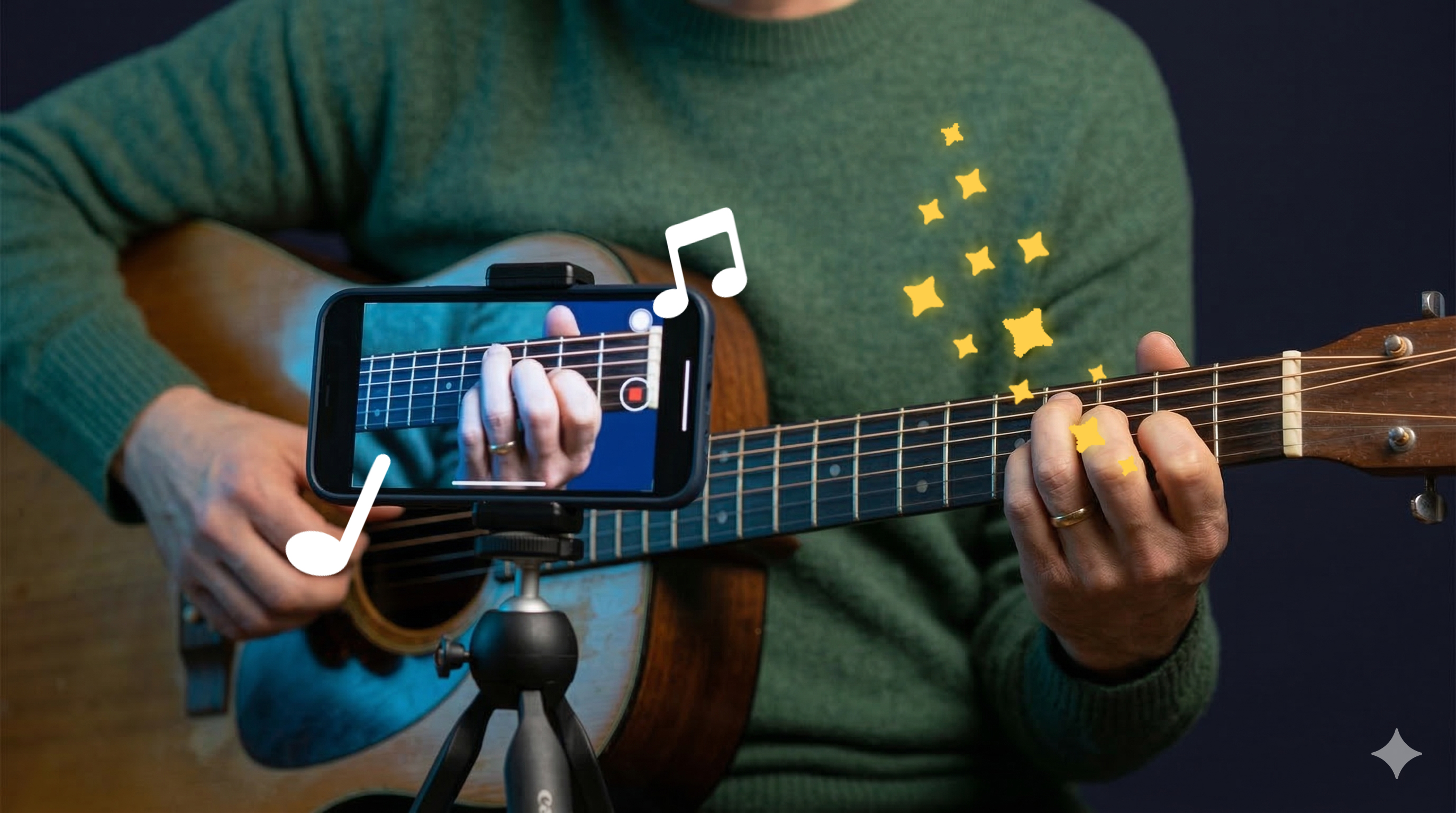
Video feedback adds another layer. Recording yourself and watching back reveals issues you can't perceive while playing. Your hand position might drift. Your posture might cause tension. Your fretting fingers might be positioned inefficiently. Video makes these visible.
The combination is powerful: watch experts to build mental models, use real-time visual feedback during practice, and record yourself for post-practice analysis. Each visual modality contributes uniquely to skill development.
How Chordie AI implements visual feedback: Real-time note accuracy display shows which notes you're hitting correctly. Chord visualization displays proper finger positions before you play. Progress charts track your accuracy, timing, and practice consistency over time. The AI combines visual feedback with audio feedback, giving you multiple streams of information about your playing.
To maximize visual feedback benefits:
Watch tutorials before attempting techniques. Let your brain build visual models first.
Use apps with real-time feedback during practice. Don't just play — watch the feedback and respond to it.
Record video of yourself playing regularly. Review the recordings with a critical eye for technical issues.
Track your metrics over time. Progress graphs motivate and reveal patterns in your improvement.
Compare your hand position to reference images or videos. Visual comparison catches issues that feel normal because you've done them the same way for so long.
Visual learning accelerates guitar acquisition at every level. From complete beginners seeing chord diagrams to advanced players analyzing their technique on video, visual feedback provides information that audio alone cannot. Embrace it, and watch your progress accelerate.
Chordie Team
VerifiedMusic Education Experts
The Chordie Team consists of professional guitarists, music educators, and AI engineers passionate about making guitar learning accessible to everyone. With decades of combined teaching experience, we create content backed by proven pedagogical methods.
Learn more about usShare this article